Hasegawa 1/32 P-40L Warhawk
|
KIT #: |
08024 |
|
PRICE: |
3,680 Yen |
|
DECALS: |
Probably three options |
|
REVIEWER: |
Tom
Cleaver |
|
NOTES: |
Decals: Zotz
ZTZ32-035 “North African Warhawks” Conversion set: Greymatter
Conversions P-40F/L Set |
In an effort to improve the performance of the P-40
above 15,000 feet, Curtiss decided to replace the 1,200 h.p. V-1710 Allison and
its single-stage, single‑speed supercharger, with a Packard V‑1650 Merlin
producing 1,300 h.p. and using a single-stage, two-speed supercharger. A
Rolls‑Royce Merlin engine was first installed in a P‑40D to produce the XP‑40F,
which flew on October 23, 1941. The production P‑40F Warhawk, became the first
American fighter to use the Packard Merlin; with a top speed of 364 mph, the
P‑40F was 10 mph faster than the P‑40E with an increase in altitude performance,
though not as much as had been hoped for. The major external difference between
the P‑40E and P-40F was the absence of the upper air scoop on the P‑40F cowling,
though there were additional differences in the radiator ducting and exhaust,
due to the Merlin's updraft carburetor. 1,311 P‑40F Warhawks were built during
1942, along with 700 similar but lighter‑weight P‑40L Warhawks produced through
early 1943. The P-40F-1 had the short fuselage of the P-40E, while the P-40F-5
and all following utilized the long-tail
 fuselage
introduced in the P-40K-5.
When the supply of P‑40F and L airframes outstripped the
supply of Packard Merlins early in 1943, 600
were completed with Allison engines; designated P‑40R,
they were used as fighter trainers.
fuselage
introduced in the P-40K-5.
When the supply of P‑40F and L airframes outstripped the
supply of Packard Merlins early in 1943, 600
were completed with Allison engines; designated P‑40R,
they were used as fighter trainers.
The RAF received approximately 100 P-40F Warhawks, which
were designated “Kittyhawk II.”
While the majority of P-40F and P-40L Warhawks served
with the USAAF in the Mediterranean Theater, some were also sent to the Solomons,
where they equipped the 18th
Fighter Group for a short time in early 1943.
The Merlin Warhawks finally left first-line service in
the Italian Theater during the spring of 1944, when they were replaced in the
fighter-bomber role by the P-47 Thunderbolt.
The 325th
Fighter Group:
The 325th Fighter Group, composed of the 317th, 318th,
and 319th Fighter Squadrons, was activated
August 3, 1942,
at Mitchell Field,
New York.
The unit moved to
Providence,
Rhode Island
at the end of the month to train for overseas combat, then transferred to
Langley Field,
Virginia,
on
January 2, 1943,
where they were equipped with new Merlin-powered P-40F Warhawks and spent
several days training to launch from an aircraft carrier.
On
January 7, 1943,
the group flew to
Norfolk,
Virginia,
where they went aboard USS Ranger, for
transit to
North Africa.
They arrived off
Casablanca
on January 18, and were launched from Ranger
on the 19th, flying to their base
at
Tafaraoui,
Algeria.
The 31th Fighter Squadron flew the group's first combat
mission on
April 17, 1943,
escorting B-25 Mitchells attacking German positions in the Mareth Line in
Tunisia.
In late May, 1943, following the surrender of Axis
forces in North Africa, the 325th
FG participated in the campaign against the island of Pantelleria, during which
they became the first P-40s to carry 1,000-lb bombs on dive-bombing missions.
During the campaign, the 325th
FG flew 33 missions totaling 652 sorties, with 16 missions flown in one five-day
period.
At the height of the campaign, 6 missions were flown in one day.
These missions included dive-combing, strafing, and
bomber escort.
Following the surrender of Pantelleria - the only enemy
base to surrender to an air campaign during the war - the 325th
FG moved to the island and began operations against
Sicily
in late June, 1943.
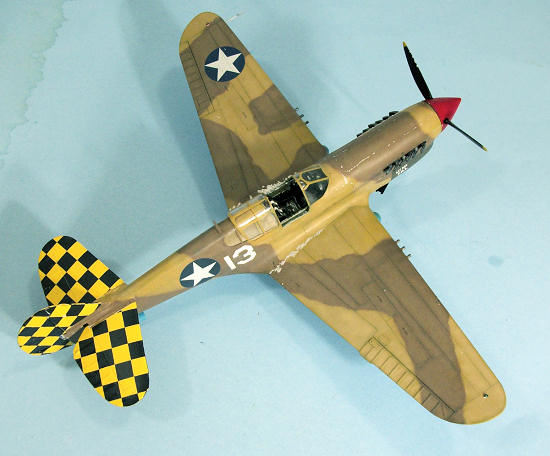
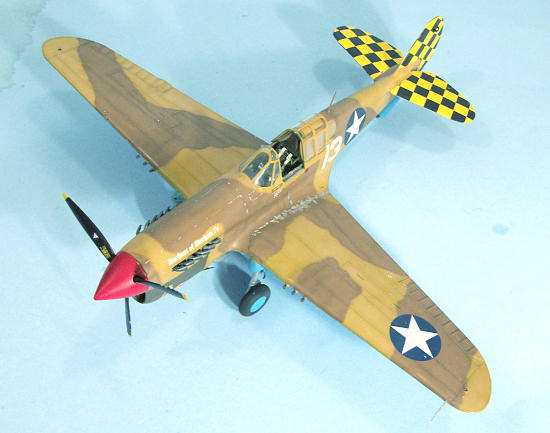
At this time, they began painting the tails of the P-40F
and P-40L Warhawks with yellow and black checker markings, and became known as
“The Checkertail Clan.”
 During the air campaign in July and August 1943 over
Sicily
and
Sardinia,
the 325th FG flew several
spectacular missions, including one where they destroyed 12 seaplanes and
damaged another 6 at the Stagnono Anchorage in
Sicily.
In another, the 317th
and 318th Fighter Squadrons
destroyed 17 out of 25 enemy aircraft encountered over southern
Sardinia.
During the air campaign in July and August 1943 over
Sicily
and
Sardinia,
the 325th FG flew several
spectacular missions, including one where they destroyed 12 seaplanes and
damaged another 6 at the Stagnono Anchorage in
Sicily.
In another, the 317th
and 318th Fighter Squadrons
destroyed 17 out of 25 enemy aircraft encountered over southern
Sardinia.
On
July 30, 1943,
20 P-40s of the 317th FS, and 16 of
the 319th FS, flew a fighter sweep
over
Sardinia.
Over
Sassari,
the 317th FS was attacked by 25-30
Bf-109s and approximately 18-20 C.202s just before they were to rendezvous with
the 319th FS.
In the brief, intense battle, the 20 P‑40s engaged and
destroyed 21 enemy aircraft, with 4 probables.
Four pilots of 317th
Fighter Squadron became aces flying the P-40F and P-40L, including Captain Ralph
G. “Zack” Taylor Jr., who scored his fourth, fifth and sixth victories in the
battle of July 30, to become the squadron's leading ace.
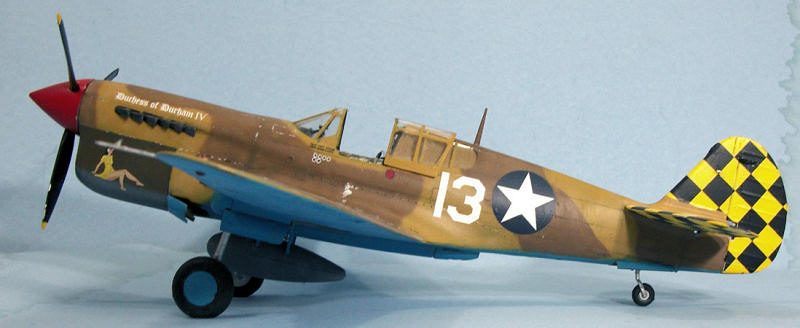
His aircraft was the well-known “Duchess of
Durham.”
By the end of the Sicilian Campaign on August 17, 1943,
the 325th FG had flown 3,233
sorties during 110 missions, shot down 128 enemy aircraft for a loss of 26
P‑40s, and escorted 1,100 bombers without loss to enemy air action, during four
months of combat.
At the end of September, 1943, the 325th
Fighter Group gave up their Warhawks and transitioned to P-47 Thunderbolts,
leaving the 12th Air Force to
become strategic escort fighters in the newly-formed 15th
Air Force.
The group went on to also fly the P-51 Mustang from May, 1944,
making them one of very few fighter groups to fly three of the four major USAAF
fighters of the war.
Among their many later achievements was flying the first
Italy-Russia
shuttle mission in June 1944.
Hasegawa has released kits of every Allison-powered
P-40, but has yet to produce the Merlin P-40 in any scale.
In 1/48, this problem could be solved by the use of a
resin nose produced by AMTech to correct their release of the
AMT
P-40F.
In 1/32, the lack of a Merlin P-40 has now been taken care of by
Greymatter Conversions, with the arrival of their eagerly-awaited conversion
set.
Designed by Derek Bradshaw of
BAC,
this is the only 1/32conversion for the Merlin P-40 that accurately portrays the
radiator ducting and exhaust (which is one reason w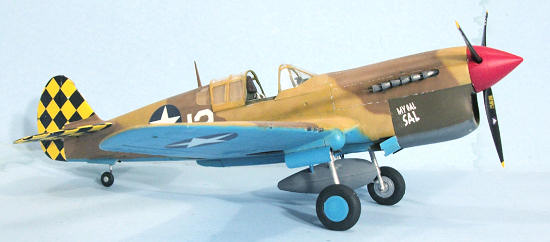 hy
the set was delayed several months while this was researched).
hy
the set was delayed several months while this was researched).
The conversion set can be used to create either an early
short-tail P-40F, or an early long-tail P-40F or the late-production P-40L,
which is primarily distinguished by the small window in the left windshield
quarter panel.
Greymatter Figures has also produced a resin “long tail”
replacement for those modelers who cannot find the P-40M kit and end up using
the P-40E kit.
The best Hasegawa kit to use for the conversion is the “Kittyhawk
I/III”
release, which includes the two different windscreens, the two different tails,
and the two different sets of exhaust, allowing a modeler to do any Merlin P-40
version they desire.
This was a limited-run kit released last May, so you may
have to look around to find one if you didn't get hold of it right off.
Zotz Decals also released ZTZ32-035, “North African
Warhawks,” in cooperation with Greymatter, to provide markings for six different
P-40F and P-40L Warhawks, including a short-tail P-40F from the 78th
Fighter Group, an early P-40F transferred to G.C.II/5 “Lafayette Escadrille” of
the French Air Force, a P-40L of the 325th
Fighter Group, and a P-40L of the 324th
Fighter Group.
All are in desert camouflage.
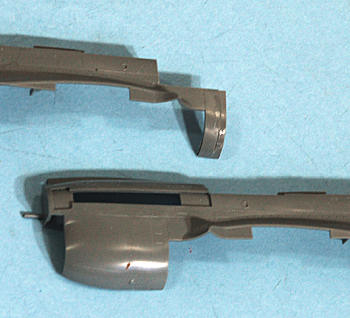 The conversion set is designed to allow a modeler to cut
away the plastic engine cowling along panel lines, and replace it directly with
the resin replacement.
This comes in two main parts - the engine cowling and
the radiator cowling - along with the radiator parts, the cowling intake and the
cowling flaps with their associated control linkages.
The conversion set is designed to allow a modeler to cut
away the plastic engine cowling along panel lines, and replace it directly with
the resin replacement.
This comes in two main parts - the engine cowling and
the radiator cowling - along with the radiator parts, the cowling intake and the
cowling flaps with their associated control linkages.
After cutting off the nose of each forward fuselage
half, I then attached the long-tail rear fuselage part to each forward fuselage
part before proceeding.
I then glued the fuselage halves together, and then
attached the resin replacement parts.
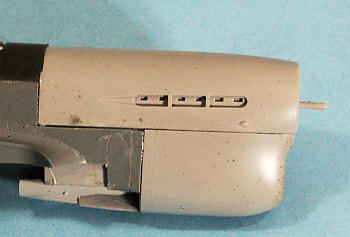 Any modeler
who has done this sort of modification surgery to a kit before should have no
problem doing this, thanks to the very clear drawings included in the
instructions that come with the conversion set.
Any modeler
who has done this sort of modification surgery to a kit before should have no
problem doing this, thanks to the very clear drawings included in the
instructions that come with the conversion set.
While the fuselage sub-assembly was setting up, I
assembled the wing.
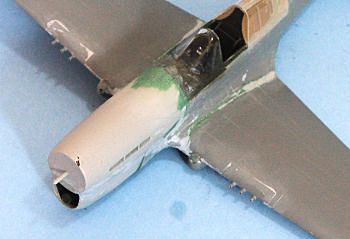
I then painted the cockpit, assembled it, and installed
it in the fuselage. I finished off by assembling the fuselage and wing, and
attaching the horizontal stabilizers.
I then found I needed to apply some putty to the upper
area of the resin cowling attachment to the fuselage to get a smooth fit.
When that was done, I filled all the seams and joints
with Tamiya's version of “Mr. Surfacer.” I sanded everything smooth and then
rescribed panel lines where necessary.
Painting:
I used Gunze-Sangyo “Dark Earth” and “Middle Stone,” and
Xtracrylix “Azure Blue.”
There has been much discussion over the years about
whether the Merlin P-40s in the
Mediterranean
used Azure Blue or Neutral Grey.
I have Jeff
 Ethell's
“World War II In Color” series, and there are several photos of P-40Ls in Volume
2 which clearly show that at least the late production Merlin P-40 did use Azure
Blue.
Ethell's
“World War II In Color” series, and there are several photos of P-40Ls in Volume
2 which clearly show that at least the late production Merlin P-40 did use Azure
Blue.
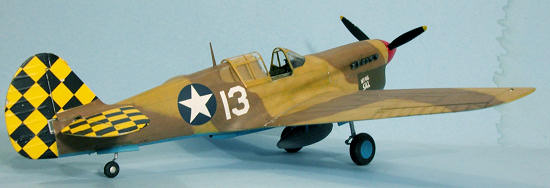
I followed the instructions for doing “Duchess of
Durham,”
with the replacement Olive Drab/Neutral Grey lower cowling.
I painted that, masked it off, then freehanded the rest
of the camouflage scheme according to the painting diagram supplied in the Zotz
sheet, going back over each upper surface color to get various levels of
sun-fading by adding light grey and white to the mixtures.
I finished off with a coat of Future.
Decals:
The Zotz decals went on without problem, though I did
have to slice along the control surface separation lines with the Checkertail
decals to get them to set down completely.
I used the kit decals from a P-40E for the wing national
insignia, because the blue in those markings was a lighter shade that did a good
simulation of sun-fading.
I gave the model several coats of Xtracrylix Flat
varnish, with some Tamiya “Flat Base” added in to get the dead-flat sun-faded
finish seen on North African-based aircraft.
I then attached the landing gear and prop, and the
separate exhaust stacks.
Exhaust stains were done with Tamiya “smoke” and some
“dinging” to match the photos I found of the 1:1 “Duchess of Durham” flown by
Captain Ralph G. “Zack” Taylor Jr., the 317th
FS leading ace.
I finished off by unmasking the cockpit glass and attaching the
canopy in the open position.
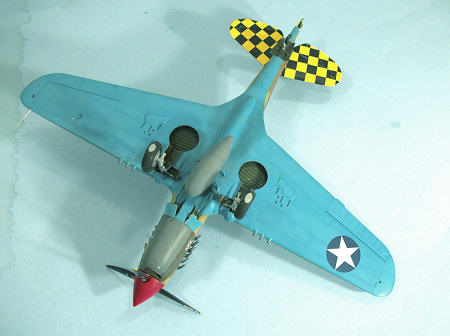 I really don't know why Hasegawa hasn't done a Merlin
P-40 in their series.
Perhaps they couldn't find that detail information Derek
Bradshaw had to search out for so long.
This is an easy conversion for anyone with experience of
kit conversions, and the result is a great-looking model that pretty much
finishes off the major versions of the P-40 Warhawk series.
Highly recommended.
I really don't know why Hasegawa hasn't done a Merlin
P-40 in their series.
Perhaps they couldn't find that detail information Derek
Bradshaw had to search out for so long.
This is an easy conversion for anyone with experience of
kit conversions, and the result is a great-looking model that pretty much
finishes off the major versions of the P-40 Warhawk series.
Highly recommended.
Tom Cleaver
December 2010
Copyright ModelingMadness.com. All rights reserved. No reproduction in part or in whole without express permission.
If you would like your product reviewed fairly and quickly, pleasecontact
the editor or see other details in the
Note to
Contributors.
Back to the Main Page
Back to the Review
Index Page 2024