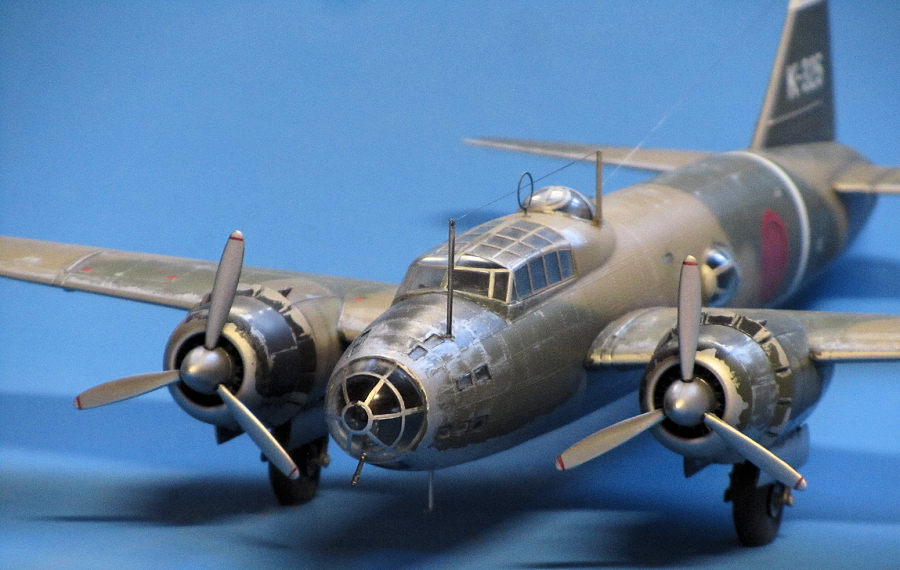
Hasegawa 1/72 G4M1 Betty
| KIT #: | 51815 |
| PRICE: | $25-45.00 |
| DECALS: | Two options |
| REVIEWER: | Ryan Grosswiler |
| NOTES: | 1969 tooling. Falcon canopies. Mini world guns. |
| HISTORY |
With a shallow glance at final outcomes and a
thoughtless acceptance of “known truth”, it's
all too easy to develop an inaccurate picture of full reality. Though the
airplane modeled here
would later garner legendary derision from both Allied pilots and its own
crewman when forced
to operate unescorted and in small numbers toward the end of the war, it was
during an earlier
stage that the G4M provided the opposite impression: It was an integral part of
the Japanese
fist that decked the US and UK so badly in the first months of 1942.
Like so many other aircraft of the period, its origin story began about ten
years earlier. The
Japanese Navy had all along recognized the basic challenge of maintaining
a far-flung island
empire, namely that short ranges from forward base to target were completely out
of the
question and that any bombing operations would likely be conducted over vast
distances of
featureless ocean.
 Admirals
Yamamoto and Matsuyama, then senior technical staff in the Imperial Navy, were
Admirals
Yamamoto and Matsuyama, then senior technical staff in the Imperial Navy, were
working in the early 1930s not only under this overarching problem but also on
strategies to
achieve technical parity with the Western powers. The two officers were
apparently thinking
along the lines of bomber men like Billy Mitchell and Hugh Trenchard, for among
advances in
predicable fleet-based aircraft categories of fighter, dive and torpedo bomber,
they created a
new one unique to any naval power: a multi-engined land-based attack aircraft
with sufficient
range and payload to support surface fleet task force operations.
The first product of the effort was the G3M "Nell", the work of chief
designer Kiro Honjo and
his staff at Mitsubishi. Just as this superb aircraft was entering service, its
successor began to be
visualized. The requirements for performance floated by the Navy were severe by
1937
standards: 250 knot max speed over 2500 nautical miles with a 2000 lb bomb load,
all using the
same class of engine as in the G3M. Honju felt that this pointed to a
four-engine bomber, but in
what must have been an exasperating moment for Honju and his team, the first
design
conference between customer and vendor devolved into a shouting match; their
Imperial Navy
client angrily insisting on a twin-engined layout. This stance only became
possible with the
successful development of the Mitsubishi's new Kasei fourteen-cylinder radial
developing 1500
hp on takeoff.
Even with these new, powerful engines, achieving the required range required a
concentrated
effort to eliminate every potential source of weight-build up during the design
process. The
lack of crew and systems protection was therefore not a stupid omission on the
part of
Mitsubishi's design team, as is often implied in older Western publications, but
a thoughtful,
conscious philosophy to achieve the insisted-upon performance. Crew and systems
protection
were omitted and the airframe was so light that stress margins were quite
narrow. It required
that the aircraft be equipped with one of the first applications of 'wet wings',
i.e. portions of the
wing structure itself were sealed off to create the fuel tanks. The one
exception to this process
was the incorporation of a 20mm cannon in the tail, a response to bitter
experience in China.
This station swelled the aft fuselage to create the famous cigar-like profile
that led Honju and
his team to call it namekuji--'the slug'. But their careful attention to detail
paid off, the
prototype when flown e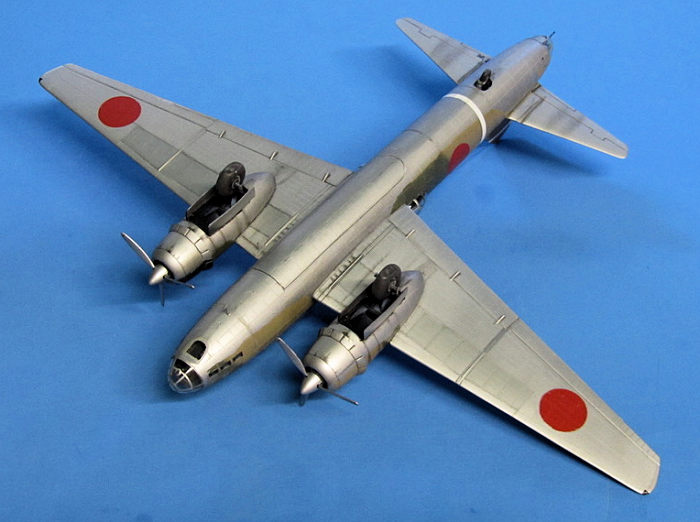 xceeded
the stringent requirements by a considerable margin.
xceeded
the stringent requirements by a considerable margin.
Some minor directional stability problems were resolved in the second
prototype, and the new
bomber seemed set to enter production in the Spring of 1940 when events in China
led the IJN
to force Mitsubishi to develop an escort version of the aircraft: no bombs but
lots of extra guns
and ammunition. The pointless distraction delayed the bomber as 30 such
'fighter' airframes
were produced before the Japanese came to the same conclusion as the Americans
would later
with their YB-40 version of the B-17: aircraft equipped this way do not
contribute to the
defense of the formation in any meaningful way but do slow it down once the main
force has
dropped its bombs. Delayed like this, the first proper bomber airframe rolled
off Mitsubishi's
production lines in December, in stuffy bureaucratic nomenclature designated
'Mitsubishi Navy
Type 1 Attack Bomber G4M1'.
About thirty aircraft were available and delivered when the first unit took
the airplane to
forward bases in China at the end of July 1941. The IJN was pleased to discover
that the new
bomber could keep pace with the new Zero fighter also just entering service, and
the bombers
could as a bonus provide the escorting fighters navigational guidance. However,
the Chinese at
that stage would not engage the enemy's bomber formations unless they were
certain there
were no escorts, so there was little action apart from what amounted to
(admittedly valuable)
long-range navigational training flights.
Regardless, the Japanese seizure of southern French Indochina that same month
prompted
economic sanctions from the United States, which in turn had the unintended
consequence in
the Japanese general staff of triggering detailed planning and preparations for
war with the
West. The TDY was cancelled and the new G4M units pulled back to metropolitan
Japan for
intensive training for the upcoming war.
The final decision to go to war against the Western Allies was made on 1
December.
December 8 (across the international date line) opened with a general assault by
Japanese
aircraft against the American forces at their Philippine bases, these achieving
the desired
element of surprise. But the attack at Clark Field stung the worst: here, the
Americans had been
alerted events at Pearl Harbor and scrambled their fighters, but the Japanese
squadrons
targeting the area had been delayed by fog, meaning that the defending fighters
were landing
to refuel when the mixed force of G3Ms and G4Ms arrived. The 42 tons of bombs
dropped on
the field landed almost entirely within the airfield perimeter, and the USAAF
lost about 40
aircraft. The field at Iba was also hit, and more aircraft were lost along with
the only functioning
American radar in the Philippines. By the end of the day the USAAF was down half
of its heavy
bomber force and 35% of fighter strength in the Philippines. The Japanese had
lost just seven
Zeros with a single G4M crashing just short of its base on the return flight.
 Simultaneously, near Singapore, the Japanese were searching intensively for the
UK's Eastern fleet and its two battleships, the Prince of Wales and Repulse, the
former fresh from its
Simultaneously, near Singapore, the Japanese were searching intensively for the
UK's Eastern fleet and its two battleships, the Prince of Wales and Repulse, the
former fresh from its
celebrated action against the Bismarck in the Atlantic. After some false alarms
and missed
contacts, these were finally fixed on the 10th, a chance sighting of a Walrus
amphibian giving
away the ships' position, and they were attacked at about noon. Prince of Wales
was hit and
crippled immediately with severe damage to its steering and propulsion, while
Repulse
managed through some impressively skillful maneuvering to evade all of the first
salvo of 15
torpedoes. The Japanese switched their tactics on the spot and for the second
run at the ships
cut their torpedo release distance from 1000 meters to just 500. These scored
the hits that
doomed the Prince of Wales, but once again the Repulse evaded. The third attack
run saw the
Japanese release the last of their ordinance. Lt. Haruki Iki, leading the final
element of nine
aircraft, would recall releasing his torpedo at 800 meters and pulling up just
in time to just miss
the cruiser's bridge, and as he glanced behind saw his two wingmen get
obliterated by the
ship's AAA. However, the two victims had already dropped their torpedoes and all
three hit
their target. The Repulse sank a few minutes later. The two wingmen and a G3M
from another
unit, plus one more G4M which bellied into a rice paddy short of its base were
the only
Japanese losses.
The first few days of war closed with these aircraft having achieved a set of
incredible
accomplishments: effective, precision strikes including one involving the first
time ever a naval
task force underway in the open ocean was destroyed by land-based aircraft.
These results set
the standard which would be repeated for the next half-year. Lt. Iki flew over
the site two
weeks later and dropped two bouquets of flowers, both in honor of his wingmen
and drowned
enemy, maybe the final act of respect in a war that was shortly to become
ferocious and
savage. For the Western Allies, a six-month beating had commenced, and the
bomber soon to
be known as "Betty" by the Allies would be the farthest-reaching fist
of it.
The later derision of the Allies for this aircraft was therefore probably (at
least in part) a
reaction to the humiliations it had given them earlier. Such specialization in
design usually
extracts penalties, however. As the situation changed the next version of the
bomber was
forced into being. While it looked at first glance merely like a G4M1 with more
glazing around
the nose and a proper turret up top, the G4M2 was actually a nose-to-tail,
wingtip-to-wingtip
redesign with a new wing and thicker, laminar-flow airfoil, flush riveting, and
fully integrated
fuel tank and armor protection, the very items that it had needed after those
first few glorious
months of war.
| THE KIT |
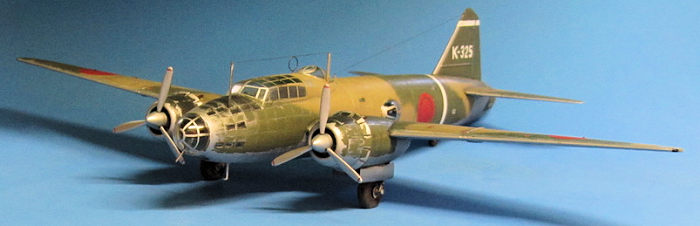 In 1967,
Lindberg was the first to create an injection-molded model kit of this aircraft.
In 1967,
Lindberg was the first to create an injection-molded model kit of this aircraft.
Hasegawa cut this one about two years later; theirs would also briefly appear
under the Frog
and AMT labels in the early '70s. Hasegawa would return to the subject and come
out with
modern molds for the G4M2 in 1996. Both of these unrelated Hasegawa kits
continue to be
reissued on a regular basis and have been consistently available in the decades
since.
For the -1, just 68 parts lay carry standard first-generation injection
molding from the '60s
across three colored (light grey, dark green, or medium gray, depending on the
year and source
of issue) sprues and one clear, some recessed panel lines but most detail is
raised and the
model is covered with fine raised rivets, those on the tail surfaces being
noticeably more
coarse. Per the standards of 1969 interior detail is sparse and smaller parts
are a little heavy-
handed. Rather inappropriately, most issues of this kit have also contained a
mini-kit of the
MXY-7 Ohka suicide weapon that would be better suited to the -2 (Hasegawa would
later pair
the two this way): the action-packed box art of these releases containing this
slyly depicting the
Ohka actually being launched from a correct -2 in the background.
Despite its age, Hasegawa's G4M1 remains a good kit. The only things wrong are
the
incorrectly-configured cockpit layout, plus the nose windows are a little small.
Modern
modelers might prefer Sword's recent kit with its de riguer recessed panel
detail, but the
availability, price, and prevalence--not to mention the far easier build
experience--of this old
classic keep it in the competition, plus those raised rivets do have their
advantages. Best of all,
the external shape is bang-on accurate.
| CONSTRUCTION |
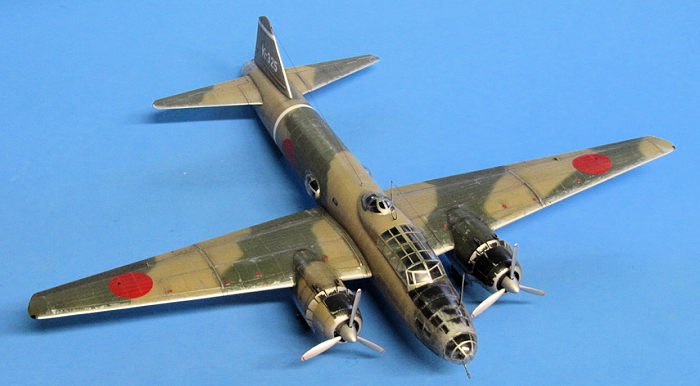 Totally a
breeze, nothing significant to report: I had to struggle to come up with
something to
Totally a
breeze, nothing significant to report: I had to struggle to come up with
something to
write here. This is an easy kit from an era where plastic models were aimed at
wee ones. Just
follow the instructions and stick the parts together! This is hands-down the
easiest multiengine
subject in 1/72 that I know of and totally suitable for the new builder with one
or two builds'
experience.
I made mine initially in 2006, and at the time incorporated some
improvements. The sparse,
inaccurate interior was replaced with a new one of striated Evergreen styrene
sheet, (especially
important as with that big greenhouse canopy it's quite visible in the completed
model--and for
the distinct, corrugated aluminum texture of the floors), a set of reshaped True
Details resin
USN-style seats, and an Eduard photoetch instrument panel. The canopies were
replaced with
those from Falcon's Set #18, though most will find the stock canopies just fine
(Dead Design
makes a mask set for it, to boot). We know now that in the G4M1 variant those
bomb bay
"doors" were in fact
simply fairings attached for ferry and other unarmed flights, and the
airplane went into battle with these removed and the ordinance exposed
semi-recessed. I
would have preferred to model this combat configuration, but information on the
area is scant
even today so the doors were left in place. Hasegawa's granite-hard, thick
plastic would have
made them a real chore to cut free, anyway.
I pulled the model out of storage in mid-2025 and decided to spiff it up with
some tools,
products, and techniques which weren't available to me in the 'aughts. My crude
stretched-
sprue Type 99 cannon in the tail was replaced by a lovely cast-brass one from
Mini World. I
pulled a mold from Hasegawa's G4M2 retraction mechanism and more refined main
wheels. As
 I was never
satisfied with the yawningly empty wheel wells, I went further by adding some
I was never
satisfied with the yawningly empty wheel wells, I went further by adding some
firewall and wing spar-box detail (plus the copied retraction parts) as best I
could from
photographs of wrecks and other sketchy information. These were built up as
separate
assemblies outside the model and placed within (after verifying fit) with
J&B Weld.
Finishing
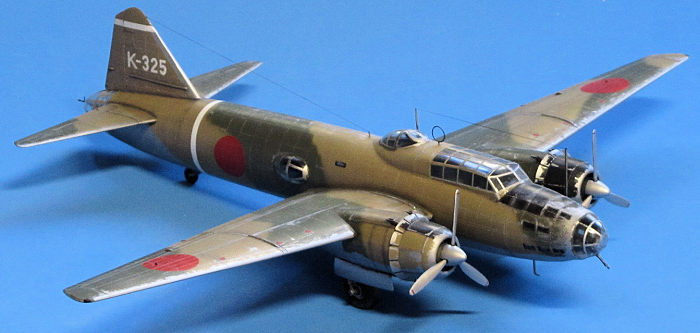
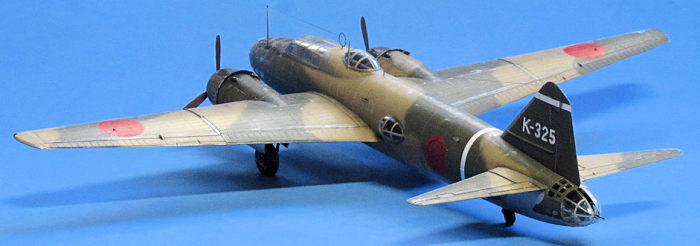
The most apparent upgrade the model would receive, however, was its finish.
Wartime
Japanese industry was not known for the high quality of paint adhesion on
aircraft, like white
Chevy trucks and vans around 2000, and airplanes in both Army and Navy service
characteristically exhibited appalling rates of exfoliation almost as soon as
they were rolled out
for their maiden. Bettys deployed to China seemed especially prone to this
problem, chipping
badly, and I mean REALLY badly, and I wanted to depict this "feature".
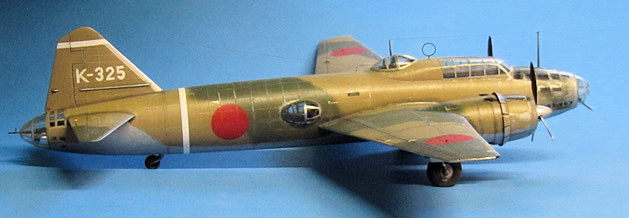
Back in '06, I had freehanded the so-called "China Scheme' in Tamiya
paints with a single-
action Paasche airbrush, not sure if I got the khaki correct (I think it's more
reddish). These left
a flat finish which would take pastels and artist's pencils well. Decals were
scrounged from
various sources in my dungeon of the time, but since then companies like TechMod
and Rising
Decals have filled the gap with lots of aftermarket options.
As for continuing that chipping where I left off in 2006, I sat down one
morning with the
model, put on some music, and proceeded to spend quality time with a Prismacolor
silver
pencil and a bit of paint and augmented my earlier effort with lots of
concentrated application,
checking the emerging effect frequently against photos. I'm far more pleased
with it this time
through.
| CONCLUSIONS |
It's always fun to discover that such an old kit
still holds up so well. Highly recommended for
modelers of all skill levels. Take the time to improve that cockpit: it's quite
visible under the
greenhouse canopy. As stated, modern, snotty modelers will probably go for the
Sword
product. However, Hasegawa's old classic is still a really good kit: accurate,
simple, zero-trouble
construction, plus Dead Designs makes a dedicated canopy mask for this product.
The raised
rivet detail is an opportunity to be seized upon to showcase heavy weathering of
this sort.
| REFERENCES |
Like many modelers, I have the usual suspects for
referencing the G4M: Famous Airplanes of
the World, Maru Mechanic, and one or two Polish Kagero books from the 1990s. But
I really
need to single out one title for its excellence in original research from
Japanese sources:
Tagaya, Osamu. Mitsubishi Type 1 Rikko 'Betty' Units of World War 2. Osprey
Publishing, UK,
2001. ISBN 1-84176-082-X
28 April 2026
Copyright ModelingMadness.com.
All rights reserved. No reproduction in part or in whole without express
permission from the editor. If you would like your product reviewed fairly and fairly quickly, please
contact the editor
or see other details in the
Note to
Contributors. Back to the Main Page
Back to the Review
Index Page
Back to the Previews Index Page