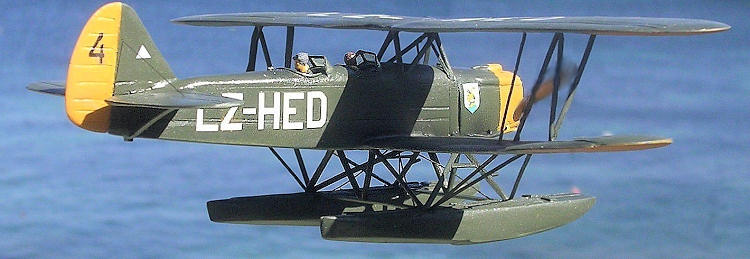
| KIT #: | ? |
| PRICE: | $14.00 |
| DECALS: | None |
| REVIEWER: | Carmel J. Attard |
| NOTES: | Basic vacuform kit |
| HISTORY |
The
Heinkel HD 42 50, later
designated the Heinkel He 42 was
a German two-seat biplene floatplane originally designed for the flying
school, and later built for the Germa Luftwaffe. The He-42 was absolete by
the start of the war. It was used as a basic trainer for many seaplane aircrew
and remained so until the end of World War II as a trainer for maritime pilots.
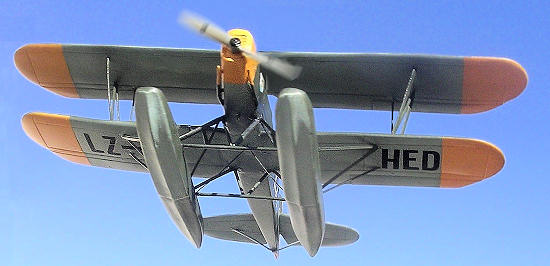 In 1929,
Heinkel developed a biplane, the HD 42, for use with the covert
military-training organization (DVS). Its fuselage was constructed out of a
welded steel tube truss and had a rectangular cross-section with a rounded top.
The engine covers were made out of light-weight metal, while the rest of the
fuselage was covered in fabric. The aircraft was equipped with floats.
In 1929,
Heinkel developed a biplane, the HD 42, for use with the covert
military-training organization (DVS). Its fuselage was constructed out of a
welded steel tube truss and had a rectangular cross-section with a rounded top.
The engine covers were made out of light-weight metal, while the rest of the
fuselage was covered in fabric. The aircraft was equipped with floats.
The HD 42
model received good feedback from the Swedish Navy, who had purchased the
aircraft, as well as from the famous pilot Gunther Plusehow (who was the first
airman to fly over the Patagonian mountains of Chile and Argentina at Tierra Del
Fuego). The prototype was equipped
with a BMW Va engine but the later
versions came with a Junker L5G engine.
Ten aircraft
had been manufactured by 1932, when a new version, the He 42C was rolled out.
Series production began with the He 42D model (14 manufactured) which were
intended for the German Air Force, which at the time was illegal. A further 189
He 42Es were built in 1934 and these aircraft were used by various flying
schools until the end of Worle War Two. Bulgaria also received possibly three of
the He-42C. These were employed on maritime reconnaissance duties but soon
relegated to training duties when more advanced types started to arrive at
Varna.
| THE KIT |
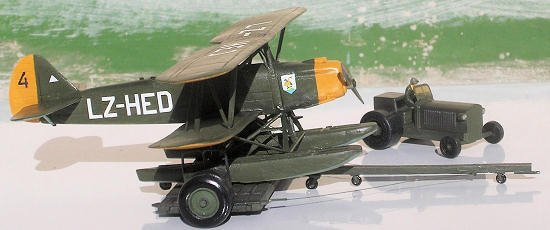 A
basic vac kit with main airframe parts. Well-detailed mouldings with recessed
panel lines. A certain degree of modelling skill is required to build vacuform
kits. They are not recommended for beginners. The 4 page A4 size instructions
contain three view, history, and exploded view of kit parts and written sequence
of building the kit stage by stage. The kit is quite basic and contained on the
backing sheet are a pair of wing main planes, 4 float halves, two fuselage
halves, a separate fin and rudder piece, two tail plane parts, a vac propeller,
two seats and two clear canopy parts. There are no struts and one have to use
after market struts like Contrail struts obtainable from Roll Models (
A
basic vac kit with main airframe parts. Well-detailed mouldings with recessed
panel lines. A certain degree of modelling skill is required to build vacuform
kits. They are not recommended for beginners. The 4 page A4 size instructions
contain three view, history, and exploded view of kit parts and written sequence
of building the kit stage by stage. The kit is quite basic and contained on the
backing sheet are a pair of wing main planes, 4 float halves, two fuselage
halves, a separate fin and rudder piece, two tail plane parts, a vac propeller,
two seats and two clear canopy parts. There are no struts and one have to use
after market struts like Contrail struts obtainable from Roll Models (| CONSTRUCTION |
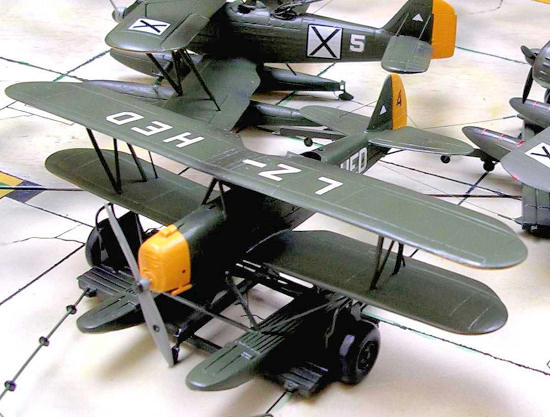 The
method is exactly the same as explained in building the He-60 described in a
recent issue. This is a slightly bigger floatplane and the instructions suggest
inserting a long flat piece of tin plate inside the wing parts that covers most
of the central part of the wings. This serves as an internal stiffener. The
lower wings have a similar one with the difference that this is slightly bent at
the wing root area so that the lower wings have a permanent slight dihedral.
The
method is exactly the same as explained in building the He-60 described in a
recent issue. This is a slightly bigger floatplane and the instructions suggest
inserting a long flat piece of tin plate inside the wing parts that covers most
of the central part of the wings. This serves as an internal stiffener. The
lower wings have a similar one with the difference that this is slightly bent at
the wing root area so that the lower wings have a permanent slight dihedral.
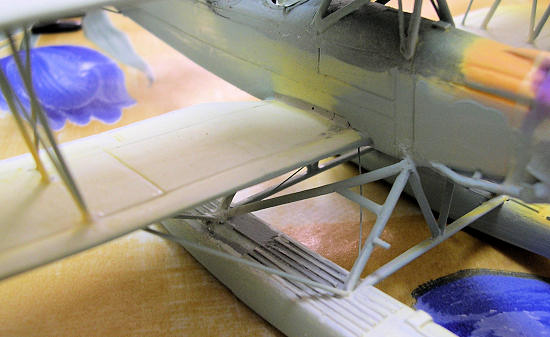
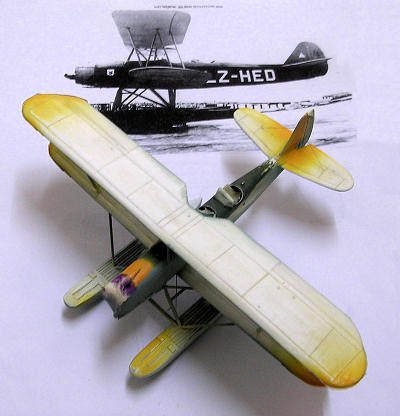 One
may find that the struts at a particular place need to be replaced with longer
ones or require reducing in overall length of a particular set of struts. This
is part of the game when building a vac form kit of this type. I have dealt with
fixing the wings and in a separate instance assembled the floats complete with
the struts and in the end merged all the pats together. I discarded the vac form
propeller given and instead fitted an exactly identical metal one which I
obtained from Aeroclub of
One
may find that the struts at a particular place need to be replaced with longer
ones or require reducing in overall length of a particular set of struts. This
is part of the game when building a vac form kit of this type. I have dealt with
fixing the wings and in a separate instance assembled the floats complete with
the struts and in the end merged all the pats together. I discarded the vac form
propeller given and instead fitted an exactly identical metal one which I
obtained from Aeroclub of | COLORS & MARKINGS |
| CONCLUSIONS |
| REFERENCES |
Carmel J. Attard
November 2011
Copyright ModelingMadness.com. All rights reserved. No reproduction in part orin whole without express permission.
If you would like your product reviewed fairly and fairly quickly, please contact the editor or see other details in the Note to Contributors.