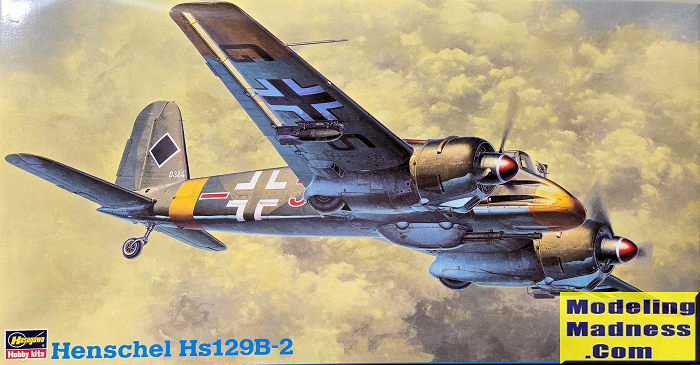
Hasegawa 1/48 Hs-129B-2
|
KIT # |
JT 71 (09071) |
|
PRICE: |
$29.98 when new |
|
DECALS: |
Two versions: 8./SG1 & 14./SG9 |
|
REVIEW : |
|
|
NOTES: |
1999 tooling |
|
HISTORY |
Henschel's Hs-129 was the Luftwaffe's first aircraft designed from the start to be used as a ground attack aircraft (the famed Ju-87 was a dive-bomber). Attempts at modifying other airframes with extra armor proved to be less than satisfactory. When the dust settled, there were two contenders, both of which performed about the same: the Hs-129 and an armored version of the FW-189. Seeing that the Hs-129 had a greater prospect of continued development as well as being a smaller aircraft and therefore a smaller target, it was chosen in September 1939.
Prototype versions of the 129 were powered by two Argus inline, air-cooled engines and had two 7.9mm MG 17 machine guns and two Oerlikon MG/FF 20mm cannon. However the preproduction Hs-129A-0 had the Oerlikon cannon replaced with Mauser MG 151/20 cannon. These weapons had a much higher rate of fire than the Oerlikon guns. It was found that the Argus engines were seriously underpowered and other than being used for initial testing and unit familiarization, were quickly passed on to training units.
Anticipating the Luftwaffe's refusal to accept the production Hs-129A-1, Henschel proposed building a slightly larger version powered by the more powerful Gnôme-Rhône 14M engine. The Luftwaffe didn't want any delays encompassed by a redesign and Henschel was told to convert the A-1 airframes to accept this new engine, the type being the Hs-120B-0. These engines were produced in two variants, each turning a different direction, one clockwise and the other counterclockwise. This prevented any torque problems with takeoff and landing. Despite the problems associated with this engine, it was used on all succeeding variants of the Hs-129.
Differences from the B-0 to B-1 were mostly minor, but the biggest was the cockpit. The vee shaped windscreen was replace with a larger, flatter paneled one. A variety of underfuselage weapons racks were available for the Hs-129 to carry a number of different weapons. Other weapons such as a pack with four 7.9mm machine guns, a bomb carrier for four 100kg bombs were designed for the 129. However, it was the MK 101 30mm cannon that really made the Hs-129 a superb anti-tank weapon.
The B-2 was version built in the greatest numbers, having just some minor differences from the B-1 including higher rated Gnôme-Rhône 14M engines and the ability to handle the BK 103 30mm gun later in 1943. The final variant was the C-1 with the 75mm cannon. There were less than a handful of these completed and only one or two actually saw any action in the last months of the war.
The 129 served primarily in North Africa and in the Eastern Front, not being used at all in the Western Front. The only air arm other than the Luftwaffe to use the aircraft was Romania, which used them against the Germans after they changed sides late in 1944.
The first pilot to earn the Ritterkreuz - Knight's Cross for his tank kills in the Hs-129 was Hptm. Rudolf-Heinz Ruffer for his 72 tank kills on 9 June 1944. He was killed by flak in July 1944. Less than a handful of 129 pilots would earn that distinction during the war.
There are no surviving Hs-129s, only a cockpit shell exists in Australia.
|
THE KIT |
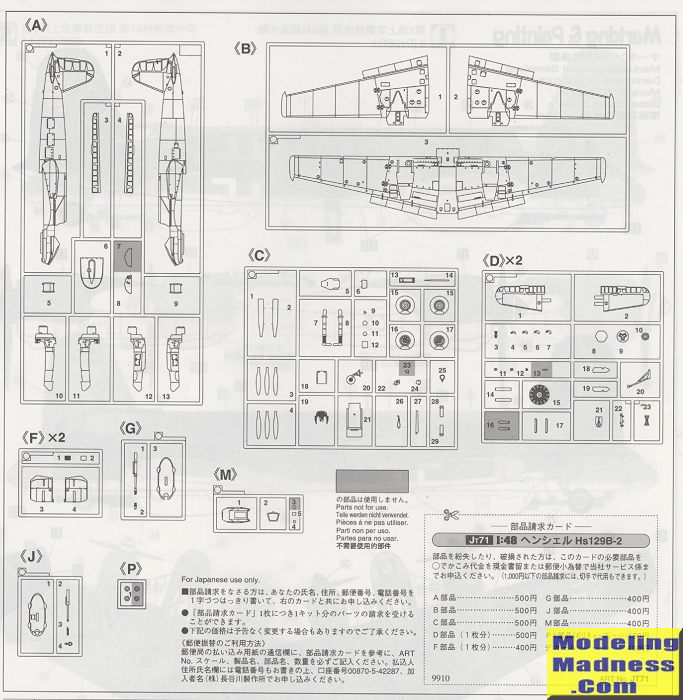 Typical Hasegawa kit of the late 90's; excellent detail and
those plastic thingies to hold in the props. All parts finely engraved in medium
grey plastic, etc. As you can see by the parts layout, there are a few bits not
used in this kit. Apparently a B-0/early B-1 or the later B-3 with the Pak 75mm
cannon is on the horizon. You have the option of two different 30mm belly
cannon, as well as wing mounted bombs. Canopy is a two piece affair that can be posed in the open
position, though in the tight cockpit, there is little to see.
Typical Hasegawa kit of the late 90's; excellent detail and
those plastic thingies to hold in the props. All parts finely engraved in medium
grey plastic, etc. As you can see by the parts layout, there are a few bits not
used in this kit. Apparently a B-0/early B-1 or the later B-3 with the Pak 75mm
cannon is on the horizon. You have the option of two different 30mm belly
cannon, as well as wing mounted bombs. Canopy is a two piece affair that can be posed in the open
position, though in the tight cockpit, there is little to see.
You do need to know that you cannot make a B-1 or B-3 from this kit. The B-3 needs the big Pak 75 cannon and the engine cowlings are not the same on the B-1 as they are with the B-2 version.
Also, the MK103 cannon wasn't introduced in service until the
Kursk offensive in July 1943, so those aircraft in North Africa all used the
older MK101 cannon. When installing the MK 103 in your Hs-129, make sure that
the muzzle brake is canted at a 45 degree angle with (looking from the front)
the side on your left higher.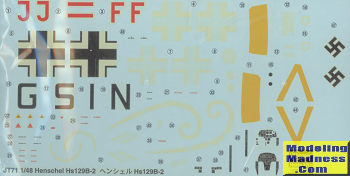
Instructions are well done with the usual Gunze paint references. Decals are for two aircraft on the Eastern Front; one early and one much later in the war, though the camouflage scheme for both is pretty much the same with the camouflage in RLM 70/71/65 with yellow eastern front markings. Decals are old school with off white whites, but should still be viable. There are aftermarket decals out there, though I'm not sure how available they might be.
|
CONCLUSIONS |
Prior to this, there was only the ESCI kit in this scale and it did the B-3 version. Since then, no new tool kit for 1/48 fans. The Hasegawa kit has been reboxed by Revell, Hobby 2000, and most recently by MN Hobby, so it is out there if interested and if you don't mind spending a lot for one. I built this kit shortly after it first came out and was quite pleased with the build so it is worth seeking out.
|
REFERENCES |
Hs-129 Panzerjäger! by Martin Pegg; Classic Publications, 1977
Copyright ModelingMadness.com. All rights reserved. No reproduction in any form without express permission from the editor.
May 2025