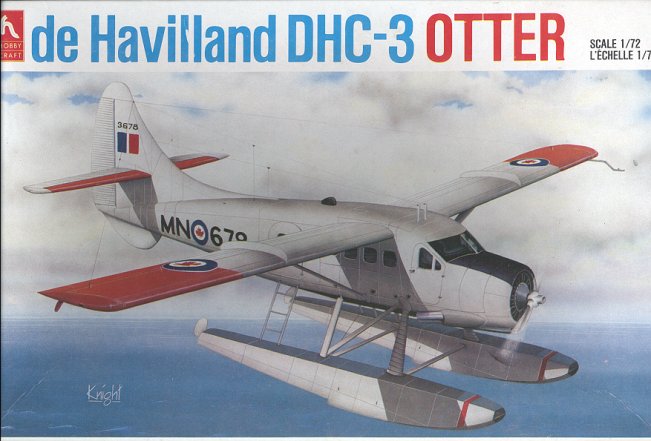
| KIT: | Hobbycraft 1/72 DHC-3 Otter |
| KIT # | 1395 |
| PRICE: | $12.98 |
| DECALS: | Two aircraft; see review |
| REVIEW & | |
| NOTES: |
| BRIEF HISTORY |
Designed as a medium haul bush plane, the DHC-3 Otter has foundfavor with more than just commercial bush operators. The type has been flown bythe military forces of several countries including Canada and the United States.Its rugged construction and relative ease of maintenance have made itparticularly useful. The US Navy has operated a number of them during itsAntarctic ventures in conjunction with the annual Operation Deep-Freeze,especially during the late 50s and early 1960s when piston powered aircraft werethe norm on the Antarctic ice.
Even today, there are a number of Otters in use. A recentconversion kit allows the use of a small turboprop engine in place of the radialengine of the original. These workhorses can be found on wheels, floats or skis,depending on the need.
| THE KIT |
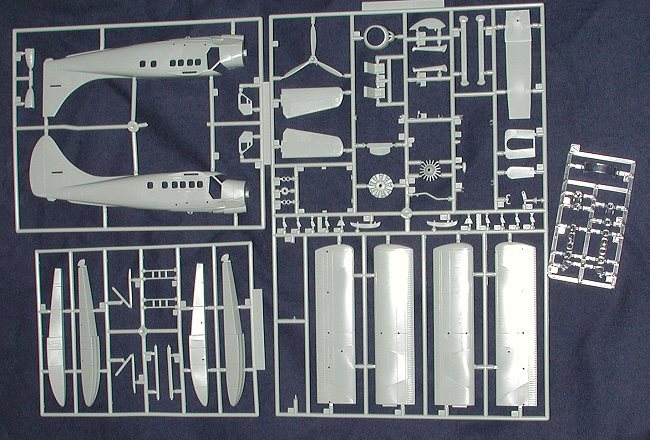
This is one of Hobbycraft's earlier kits and so is not up to thestandards of current Hobbycraft kits. While it does have engraved panel linesand is flash free, there are some sink marks, mostly on thicker parts. I couldfind no injector pin marks on any of the smaller pieces, which is a blessing.The transparencies are thick and distorted, which is really for the best asthere is little to see in the interior.
The interior consists of a cockpit with seats, instrument paneland control column. There is nothing behind the pilot and copilot, so you are onyour own for filling the back of this aircraft. The kit is meant to bebuilt as a floatplane and so there are no wheel options offered. However, thereis another boxing of this kit that includes all three. I just happened to havegrabbed this kit when it first came out so didn't get that version. There isalso an option of installing an open cargo door with a passenger door init.
Early Hobbycraft kits had two major drawbacks, instructions anddecals. Those are both evident with this kit. First off, the instructions whileadequate for assembling the kit, give no color information at all for theinterior of the kit. Only colors mentioned are in the decal and exteriorpainting section where generic colors are given. 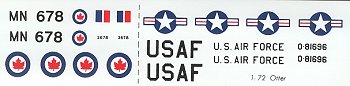 You have your choice of Otters in this regard.One is a Canadian AF version in overall aluminum with red wing and stabilizermarkings and a black underside and anti-glare panel. The other is a very similarUSAF painted aircraft, though in this case the plane is overall white withadditional red on the fin. Since the decals are basically junk, besides beingout of register, it will be up to the modeler to find alternative decals forthis kit. I know of no aftermarket decals for this kit.
Unenviably, it is often the purvey of the reviewer to note allthe things wrong with kits. Having done so, I would like to also point outseveral other things about this kit. First of all, it is the only injected 1/72Otter around and Hobbycraft should be commended on producing it. Secondly,despite what I have said about the decals, instructions and other items thatkeep the kit from being perfect, it is a very nicely done model and shouldcertainly build into a nice representation of an Otter. Of all the Hobbycraftkits I have built, none of them have been difficult to assemble. There maypossibly be shape or dimensional inaccuracies with this kit and I'll let otherscomment on them, but I see none that jump out at me.
One thing I would do when building this kit is to put a lot ofweight in the forward part of the floats to keep it from setting back as mostfloat planes I have built have been tailheavy.
Review kit courtesy of me and my wallet!
If you would like your product reviewed fairly and quickly by asite that has over 1,500 visits a day, please contactme or see other details in the