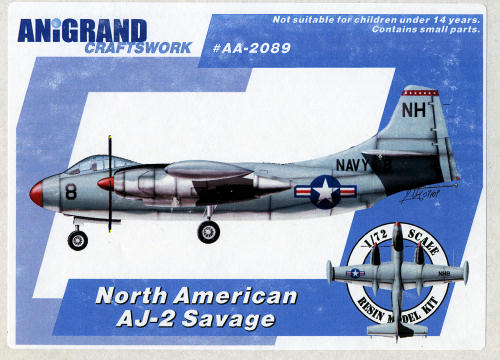
Anigrand 1/72 AJ-2 Savage
| KIT #: | AA-2089 |
| PRICE: | $106.00 from www.nostalgicplastic.com Free US shipping |
| DECALS: | One Option |
| REVIEWER: | Scott Van Aken |
| NOTES: | Full resin kit with metal landing gear and a CD with photos and modeler's notes. |
| HISTORY |
The AJ Savage was a large composite-powered carrier-borne Attack Bomber designed to deliver nuclear ordnance. It also performed photo reconnaissance duties and later on was used as an aerial refuelling platform. The North American AJ-1/2 and AJ-1/2P Savage aircraft were in a number of USN Heavy Attack Composite squadrons from 1948–1956, as well as in several Photographic Reconnaissance squadrons. The Heavy Attack versions were the first nuclear bomb carrying bombers able to be launched from and recovered on aircraft carriers. The date of its inception was a time where the US Navy was faced with procuring the nascent jet engine, while still having to rely upon the simple yet well proven reciprocating engine. Jets at this time were unreliable and used large quantities of fuel; however, once they were developed, they produced performance that no piston engine could ever provide. A compromise was made to include in the Savage two Pratt & Whitney R-2800 piston engines, with a large turbocharger fitted inside each engine nacelle. This combination made it possible for the R-2800 engines to produce rated power (2,500 hp/1,864 kW) up to 42,000 ft (12,802 m) altitude. An Allison J33 turbojet was fitted in the rear fuselage. Interestingly, both engine types used the same fuel. The piston-turbojet arrangement was intended to give added power on take-off and extra dash speed while in combat. At high altitude, this 'boxy' looking (but aerodynamically very clean) airplane was remarkably fast - more than 460 mph (740 km/h), when the jets of that era were not very much faster.
The first production Savage flew in May 1949, with the first carrier landing of the type taking place on the USS Coral Sea on 31 August 1950.
Early model Savages (AJ-1) were converted to the air tanker role, with the bomb bay filled with all the necessary equipment, including hoses, fuel pumps, electric power drive, and the drogue. Additional fuel was provided in drop tanks. AJ-1 tankers were used to refuel John Glenn's F8U Crusader during the Project Bullet transcontinental speed record flight.
The AJ-2 first flew on19 February 1953 and had uprated engines and a taller vertical stabilizer and non-dihedral tailplane.
The AJ-2P was the photographic reconnaissance version of the Savage. It carried photo-flash bombs for night missions, with most of the plane's 18 cameras being operated automatically. It was capable of night and low-level reconnaissance. The -2P also had additional fuel capacity
| THE KIT |
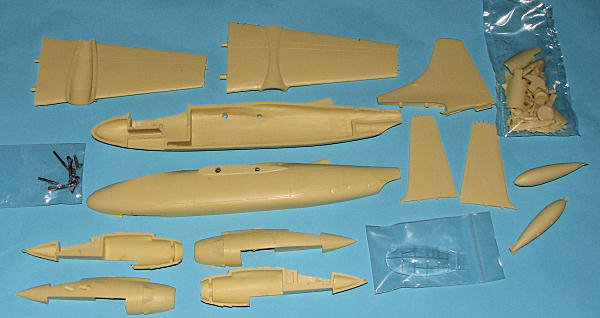 This latest kit from Anigrand incorporates a new feature from this company; cockpit interior detailing. A first for Anigrand and one that I hope we will continue to see. Having this as part of the kit means greater attention to quality control to prevent any resin blobs or unwanted air pockets in this are. It seems to have worked as the last few kits have also been glitch free in the wheel wells, where these things often form. It is not all roses as you'll still find some small voids on the wing tips, lower engine intake lips and on the side of one of the wing nacelle sections, to name a few. I also found a few pits, but these all are relatively easy to fix and to be expected.
 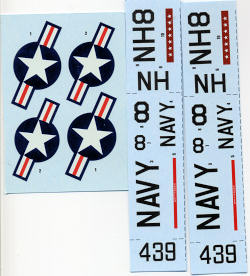 ment area is pure fiction, but the correct shape is given in the notes for those who wish to make the correction.
 | CONCLUSIONS |
| REFERENCES |
http://en.wikipedia.org
August 2009
If you would like your product reviewed fairly and fairly quickly, please contact the editor or see other details in the Note to Contributors.
Back to the Previews Index Page