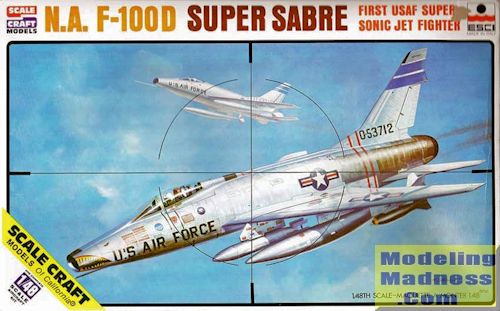
| KIT #: | 4008 |
| PRICE: | $Long out of production (thankfully) |
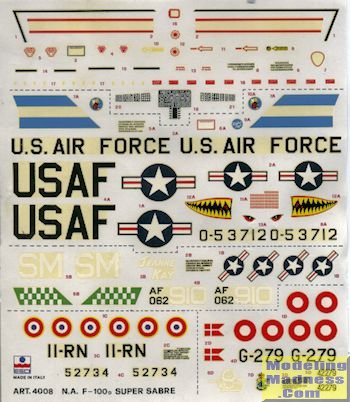
| DECALS: | Four options |
| REVIEWER: | Scott Van Aken |
| NOTES: |
| HISTORY |
"The North American Aviation F-100 Super Sabre was a sleek, swept-back-wing fighter that gave the United States a supersonic Air Force. Although the first version was produced prior to 1950, various improved versions served as trainers and as active military craft at many U.S. and foreign bases.
Since May 1953, when the first prototype model, the YF-100, bettered the speed of sound on its first flight, the versatile fighter set numerous records for speed, endurance, range and maintenance.
Late production models of the F-100D and F-100F had the capability of being launched from remote areas in the manner of manned missiles. An F-100D Super Sabre became the first supersonic aircraft to be "boosted" airborne without use of a runway in successful Zero Length Launch (ZEL) tests at Edwards Air Force Base, Calif., in 1958.
In addition to its nuclear bomb armament and four 20 mm cannons, the Super Sabre could be equipped to fire rockets and missiles, including the heat-seeking GAR-8 Sidewinder.
While the later models of the F-100 had a speed in excess of 1,000 mph, two earlier models of the "A" and "C" established the world's first low level supersonic speed records. Colonel F.K. (Pete) Everest reached 755.149 mph in October 1953, and Colonel Horace Hanes topped 822 mph in August 1955.
To demonstrate the ability of its pilot and aircraft, the Air Force chose F-100 Super Sabres to perform throughout the world in aerial precision demonstration flights. The famed "Thunderbirds," a four-man aircraft team, were viewed by over 19 million people as the storied pilots performed intricate precision maneuvers at low altitude. In Europe the "Skyblazers" flew similar demonstrations.
The jet fighter was originally powered by a Pratt & Whitney J57-P-7 axial-flow engine. Later models of the F-100 were powered by a Pratt & Whitney J57-P-21A engine. Both were two-stage turbojet engines with afterburner, rated in the 10,000-pound thrust class.
The F-100 had a service ceiling above 50,000 feet and a range of more than 1,000 statute miles.
In addition to the thin, highly swept wing and tail, the F-100 design incorporated other features that reflect an answer to the problem of supersonic flight. Heat-resisting titanium was used extensively throughout the plane. A low-drag, ultra-streamlined fuselage and canopy with but one thin-lipped air intake duct helped make supersonic speed possible. The canopy line matched the rear fuselage in a smoothly curving line so that from the side, the Super Sabre appeared to be slightly arched. Other features included automatic leading-edge slats and a low-positioned one-piece horizontal stabilizer. The F-100 was the first USAF airplane to utilize the low tail.
The plane had an automatically regulated air conditioning and pressurizing system and automatic fuel system.
Particular attention was given to placement of all controls, equipment and instruments in the cockpit for ease of operation.
| THE KIT |
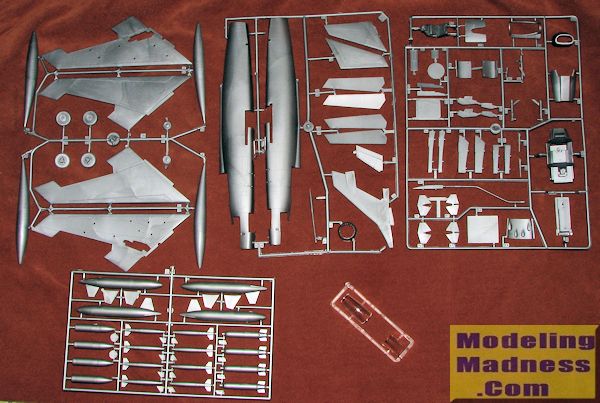 Those of us of a certain age recall when ESCI was a going concern and were generally delighted with the kits they produced. Not only did they run the gamut of genres, they also did multiple boxings of the same basic kit with different decals. Like all model companies of old, they never really disappeared even after going out of business and being purchased by AMT/ERTL as you'd then find the same kits in AMT boxes. Now days, these molds have been passed on to Italeri so you'll find the same kits in Italeri or Revell Germany boxes. Unlike old soldiers, old kits do not just fade away, unless they are really horrible.
 parts. I'd be cautious about removing flimsy parts from the sprue as ESCI's silver plastic has proven to be somewhat brittle. The cockpit canopy has a separate frame and there is a separate windscreen as well, though why someone would want to display that open with the Spartan interior is beyond me.
 | CONCLUSIONS |
To my knowledge, there have been F-100Ds produced by ESCI, Monogram and Trumpeter in this scale. So far, the Monogram kit seems to still be the leader, though apparently the Trumpeter kit isn't that terrible either. That makes the ESCI kit the odd man out in terms of what people seek in a model kit. Much of this can be attributed to age and perhaps oversimplification of the parts. As to whether it makes into an acceptable model, I cannot say as I've not built it and no one has done a build article for MM using this kit. I guess we'll just have to wait and find out.
| REFERENCES |
Historical section courtesy ofwww.boeing.com
June 2015
If you would like your product reviewed fairly and fairly quickly, please contactthe editor or see other details in the