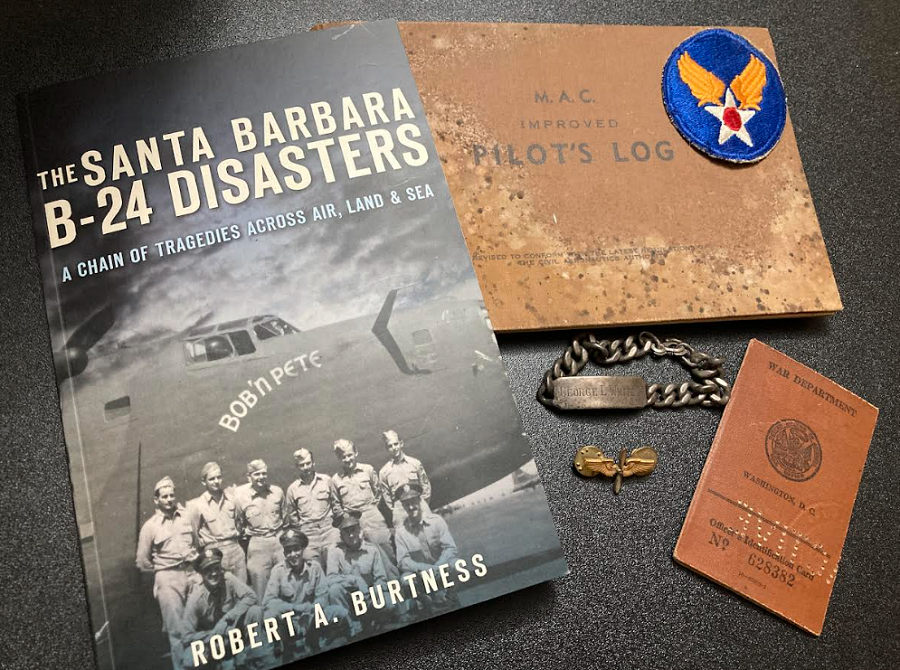
After a routine training flight in 1943, a chain of accidents occurred. First a B-24D crashed on an island near Santa Barbara, California when its engines failed one after the other. The first engine quit over the ocean and the crew was soon ordered to bail out; two jumped early and died at sea. While the eight survivors were trying to find their way home, 12 more airmen perished in a second Liberator sent out to look for them. Then in 1954, a Coast-Guard cutter searching for remaining wreckage hit a private yacht, resulting in more deaths.
Robert Burtness brings to life how a “routine” flight led to these deaths, in this local-history volume. His interest in the story began after seeing B-24 wreckage near his home in California. He then began to research the events and, in time, write a book.
While modelers may not find much here to guide them while building a Liberator, this small volume does show how flight operations proceeded for this plane. I’d not before encountered the claim that a Liberator was much more difficult to manage with a dead engine than America’s other four-engine heavy, the B-17.
I’m partial to all four-engine bombers, but I’ve a personal connection to the crew of three Liberators. An uncle who passed away in the 1950s was an ETO top-gunner, and in the 1990s, a man I met through work asked me to help edit his memoirs as a B-24 pilot in the China-Burma-India theater. In the process, I learned that his good friend in flight school was Lt. William Hatton, who piloted Lady Be Good when she crash-landed in the Libyan desert.
Finally, there’s the copilot of a plane called Bob N’ Pete. Lt. George White had been renting a home, though no longer living there, when my parents bought it in 1975. Lt. White told my dad to keep anything left in the house, which included a pre-deployment flight log, USAAC wings, pilot ID, and many photos from northern India. These include images of a crash-landed P-38, shark-mouthed P-40, and of course, lots of B-24s. One large photo taken in the US particularly interested me. I had it framed and it now hangs over one of my model cases, showing Lt. White posing with the crew of a B-24D named Bob ‘N Pete.
For years I’d tried, sporadically, to return these items to his children without success. A few months back, I was researching my uncle’s Liberator when, just out of curiosity, I searched for Lt. White’s plane. Up popped a book whose cover bore the very same photo I have in my study. It was an eerie moment indeed, and I quickly ordered a copy.
Burtness confirms that a new plane was named for two aviators who died in the training accident. The eight survivors, including White, shipped out to northern India in this Liberator; the cover photo I have was taken at a California air base before they deployed. Oversees they flew many missions, one of them eventually switching to another aircraft. Bob ‘N Pete completed low-level missions and took heavy flak damage during several missions; amazingly no crew were wounded. In the end, the war-weary bomber was written off and salvaged for parts. The seven remaining crew then joined three others on another Liberator. This plane got shot down, with all ten men surviving a bailout over occupied China. With the help of Chinese partisans, they walked 23 days back to Allied lines.
To my knowledge, this story has not been told before. I was excited to read it, though I found that Burtness’ narrative skipped around a bit too much for my tastes. That may have been the author’s choice, but other odd gaps in the story are harder to fathom. That said, these issues don’t ruin the book. In any case, gaps are inevitable today: writing veterans’ accounts of World-War-Two in our time means hunting down children, grandchildren, and personal records. I know many descendants of a vet with a box of letters and photos just waiting for publication.
It’s a pity that Burtness did not start his project two decades earlier, when more of the crew were living. He managed to interview two survivors and several children, including one of George White’s sons. I learned something new about Liberators, namely, the difficulty of flying them with an engine or two out of commission. But most of all, I learned more about Lt. White, a man I’d long wanted to meet. He passed away in the mid-1990s. At the time of writing, I’m trying through Burtness’ publisher and a local university to contact White’s family.
I may have unknowingly met a daughter whose name I had from the start, Carolyn White. She later became an award-winning Professor of English at Virginia Commonwealth University, across town from where I worked. I collaborated with their English faculty for decades, and I probably passed Dr. White in the hallway without knowing it. She died a few years ago.
It is indeed a small world, full of as many twists and turns as befell these Liberator crewmen. Pick up this book to understand the daily lives of a bomber crew in the CBI, as well as their training. It’s likely of more of interest to local-history fans than to modelers, but such works provide context for our work.
I now have serial numbers for Bob ‘N Pete, as well as Academy’s 1/72 B-24D, so I’m going to build this Liberator soon, with a diorama depicting the photo on my wall.
February 2026